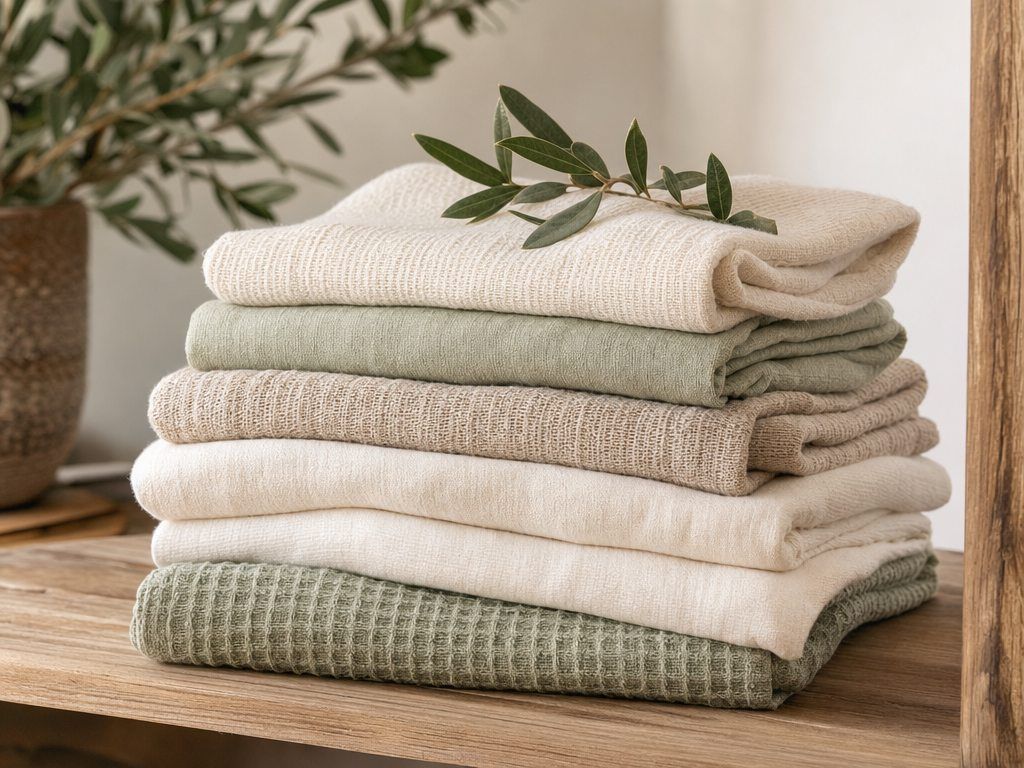
Home textiles — bedding, towels, cushion covers, table linen — involve the same material and processing considerations as clothing, with some additional factors. For wardrobe choices that follow similar principles, see this guide to building a sustainable capsule wardrobe. They are typically larger in area, laundered more frequently per item, and expected to last longer. The sustainability questions are worth applying the same way.
Bedding
Cotton remains the dominant material in bedding, and the same organic certification framework applies as in clothing: GOTS for full-chain verification, OCS for fibre-only claims. Thread count, frequently used as a quality indicator, is less useful than it appears — very high thread counts are often achieved through thread splitting or by using lower-quality multi-ply yarns, which affects durability. Long-staple cotton varieties such as Egyptian or Pima cotton generally produce softer, more durable fabric than short-staple alternatives, and are more relevant to longevity than thread count alone.
Linen bedding has grown significantly as a category. Its temperature-regulating properties suit it well for sleep: it is cool when warm and warming when cool, and becomes more supple with each wash. The environmental credentials of European-grown flax apply here as in clothing. Linen bedding typically requires a break-in period — it is stiffer when new — but rewards the investment.
Tencel (lyocell) has entered bedding as a smooth, temperature-sensitive option. The closed-loop production process gives it strong environmental credentials. It is softer initially than linen but may not achieve the same longevity over many wash cycles.
Towels
Towels need absorbency, durability, and fast drying. These properties push toward longer cotton fibres — Turkish cotton and Egyptian cotton are well-regarded for towel production — and toward structures like terry cloth that provide surface area for moisture capture.
Organic certification is available in towels and worth looking for for the same reasons as bedding. The Oeko-Tex Standard 100 certifies the finished product for harmful substance limits, complementing organic fibre claims. The processing step is particularly relevant here: towels are often treated with softeners and chemical finishes that improve initial texture but can reduce absorbency over time. A towel with no chemical softening finish may feel rougher off the shelf but perform better for longer.
Some brands have introduced linen towels, which dry faster than cotton and become softer with use. They suit those who prioritise quick-drying over immediate plush texture.
Cushions and soft furnishings
Upholstery and decorative soft furnishings involve fibre choices but also filling materials. Natural fillings — down, wool, buckwheat — are biodegradable and thermoregulating; animal welfare certifications apply to down and wool specifically. Recycled polyester fill (often labelled ‘recycled wadding’ or ‘eco fill’) addresses the synthetic footprint question while retaining the affordability and washability that makes polyester fill commercially dominant.
Buying and caring
Home textiles are an area where buying less, better applies straightforwardly. A quality linen duvet cover bought once, washed at 40°C with a full load, and air-dried rather than tumble-dried will have a substantially lower per-use impact than a cheaper cotton set replaced every year or two.
Pre-washing before use removes residual processing chemicals. Washing at 40°C rather than 60°C uses around half the energy. Air-drying outside or on a rack avoids tumble-drying energy entirely and extends fabric life. Storing linen in a cool, dry, dark place prevents yellowing. Spot-treating stains immediately reduces the need for intensive washing cycles.
The most durable home textiles are also often the most sustainable ones — and frequently the most pleasant to use. The longevity trade-off in sustainable home textiles is largely favourable in both directions.