
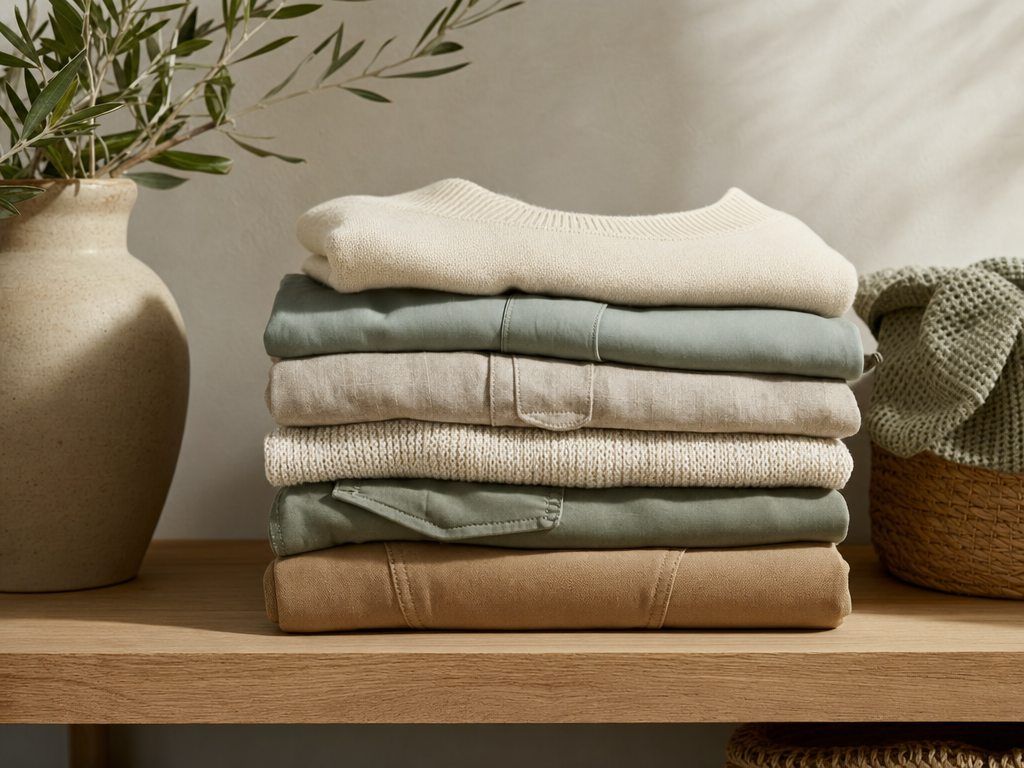
The capsule wardrobe concept has been described and redescribed many times since Susie Faux popularised it in the 1970s. Fashion Revolution estimates the industry produces around 100 billion garments a year — the capsule approach is a direct counter to that scale. The core idea is simple: a small collection of versatile, quality pieces that work together — requiring fewer total garments and generating less need for ongoing purchase. The sustainability argument follows naturally: less buying means less production, less waste, and less environmental impact per item owned.
The practical challenge is that most instructions for building a capsule wardrobe are either too vague to be actionable (‘invest in quality’) or too prescriptive to reflect actual lives (‘you need exactly three blazers, two pairs of trousers, and a trench coat’). The following is a framework rather than a formula.
Start with what you already have
Before buying anything, a complete audit of the current wardrobe. Pull everything out. Remove what is damaged or irreparable, what does not fit, and what has not been worn in the last twelve months. The remaining items are your working set.
For most people, this reveals a pattern: a small number of items worn regularly, a larger number worn rarely or never. The items worn regularly have something in common — typically they fit well, they are comfortable, and they work with other things in the wardrobe. The items worn rarely often have the inverse problem: they fit poorly, require specific occasions, or do not combine with anything else. Both observations are inputs to the next steps.
Define your actual colour palette
A workable capsule wardrobe rests on a colour palette where everything can be worn together. In practice this means choosing a base palette — two or three neutral or near-neutral colours that can sit next to each other — and a limited accent palette of colours that work with the base.
The classic base is navy, white, and tan; grey, white, and black; olive, cream, and brown. The specifics matter less than consistency. An accent colour — terracotta, cobalt, forest green — adds variety without requiring dedicated neutral items to accompany it, provided the accent works with everything in the base.
This is a practical, not aesthetic, argument. A wardrobe where most items can be worn with most other items has exponentially more outfit combinations per number of garments than one where pieces require specific companions. A 12-piece wardrobe with a coherent palette generates more daily options than a 40-piece wardrobe without one.
Invest in fit and quality for high-frequency items
Some pieces are worn repeatedly; others are worn rarely. The budget and quality calculations are different for each. A white Oxford shirt worn three times a week justifies significant investment — a well-made version at £80 worn 150 times in a year has a per-wear cost of 53p; a £25 version that fails after 30 wears costs more than twice as much per wear, and generates more waste. The financial and sustainability arguments align.
High-frequency items typically include one or two pairs of trousers or jeans in a core colour, a few versatile shirts or tops in base palette colours, a well-fitting blazer or structured outer layer, and a winter coat. These are the pieces worth buying well, trying in person where possible, and repairing when necessary.
Low-frequency items — special occasion wear, holiday pieces, highly specific seasonal items — are candidates for rental, secondhand, or deliberate restraint in buying.
The secondhand layer
A sustainable capsule wardrobe does not require buying everything new. Secondhand sources — charity shops, consignment, peer-to-peer platforms — extend the life of existing garments and reduce demand for new production. Understanding what organic and ethical certifications actually mean helps identify secondhand pieces worth investing in. They also provide access to quality at lower cost, which makes higher-standard items available at a wider range of price points.
Secondhand works particularly well for core wardrobe items in classic cuts: a quality wool coat, a cashmere jumper, a well-made pair of leather shoes. These items are durable, long-lasting, and relatively immune to the trend cycles that make secondhand fashion unpredictable in other categories.
Maintenance as part of the strategy
A capsule wardrobe built around quality items requires attention to care. Washing at lower temperatures, air-drying, proper storage, prompt repair of minor damage — these extend garment life significantly. A cashmere jumper stored unfolded on a hanger will stretch and distort; the same jumper stored folded in a drawer will last decades. A pair of leather shoes resoled when the sole thins will outlast multiple pairs left until they fail entirely.
The cost of good care — a laundry bag, wooden hangers, a pilling stone for knitwear, occasional visits to a cobbler or tailor — is low relative to the extension of garment life it provides. The sustainable capsule wardrobe is not a one-time purchase decision; it is a maintenance practice.
Tool
Is this purchase worth it?
Use the cost-per-wear calculator to find out whether any garment earns its place in your wardrobe before you buy.