
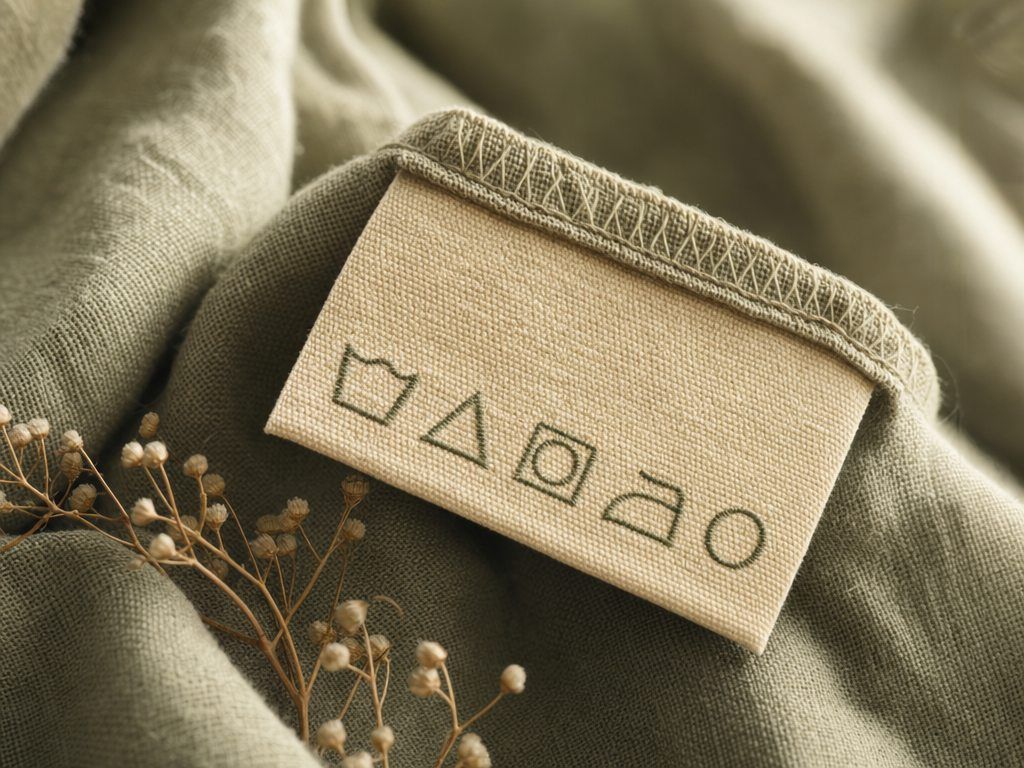
The care label sewn into a garment is, in most cases, a conservative estimate — and understanding them is one of the most practical steps covered in our sustainable home textile guide. Manufacturers write care instructions to protect against the worst-case wash, the most aggressive setting, the most colour-reactive dye. Following them correctly preserves garments; understanding what they mean allows for more intelligent care decisions.
The symbols on UK and European care labels follow the ISO 3758 standard — a consistent set of icons for washing, bleaching, drying, ironing, and professional care. They have been in use long enough that most consumers recognise the basics. The detail in the symbols is where useful information lives.
The washing basin
A tub of water with a number indicates machine washing at that temperature maximum. The horizontal lines beneath the tub indicate the programme: no lines means a normal cycle, one line means a synthetic or gentle cycle, two lines means a very gentle (delicate/handwash) cycle. A hand in the tub means handwash only. A crossed tub means do not wash — professional cleaning only.
Temperature matters because heat degrades fibres, fades dyes, and causes shrinkage. Wool and silk are most vulnerable to temperature — washing at 40°C when 30°C is recommended is often enough to cause irreversible shrinkage. Cotton is more forgiving, but repeated high-temperature washing accelerates wear. The default position — washing at the lowest effective temperature for the soil level — extends garment life and uses less energy.
Drying symbols
The square represents drying. A circle inside the square indicates tumble-drying; dots indicate heat level: one dot means low heat, two dots means medium, no dot means no heat (air only). A line through the square means do not tumble dry. A square with a horizontal line at the top means hang dry. A square with three vertical lines means drip dry. A square with a curved line at the top indicates flat drying — important for heavy knits and swimwear, which can stretch irreversibly under their own wet weight if hung.
Tumble-drying is the care step with the most destructive potential after excessive heat in washing. The mechanical action of tumble-drying — constant rotation and impact against drum walls — breaks down fibres faster than almost any other washing routine. Air-drying is gentler and uses no energy. The combination of cold washing and air-drying is the single most effective change for extending garment life.
Ironing
The iron symbol with dots follows the same logic as the dryer: one dot means low heat (synthetic fabrics), two dots medium (silk, wool), three dots high (cotton, linen). A cross means do not iron; a cross with steam lines means iron without steam.
Steam and heat can damage embellishments, screen prints, and embroidered details. The iron setting also determines whether a garment emerges crisp or scorched — linen at the correct high-heat setting with steam is a different result from linen at the wrong temperature.
What the labels do not tell you
Care labels do not specify detergent type, wash frequency, or storage requirements — all of which affect garment longevity. Enzyme-based detergents can damage protein fibres (wool, silk, cashmere) over time; specialist wool detergents preserve them. Washing less frequently reduces the cumulative stress on fibres. Storing knitwear folded rather than hanging prevents stretching.
Labels also do not reflect that many garments can be washed at lower temperatures than specified without negative effect. A ‘wash at 40’ label on a cotton item means 40°C is safe — not that 30°C will cause problems. The trade-off is effectiveness for heavy soiling, which is not relevant for light-use garments.
The underlying principle: care labels define the safe maximum. Working below that maximum, with appropriate detergent, and drying gently extends garment life significantly. A well-cared-for quality garment lasts years longer than the same garment treated carelessly — and the environmental arithmetic of longevity makes correct care a straightforward sustainability intervention.